
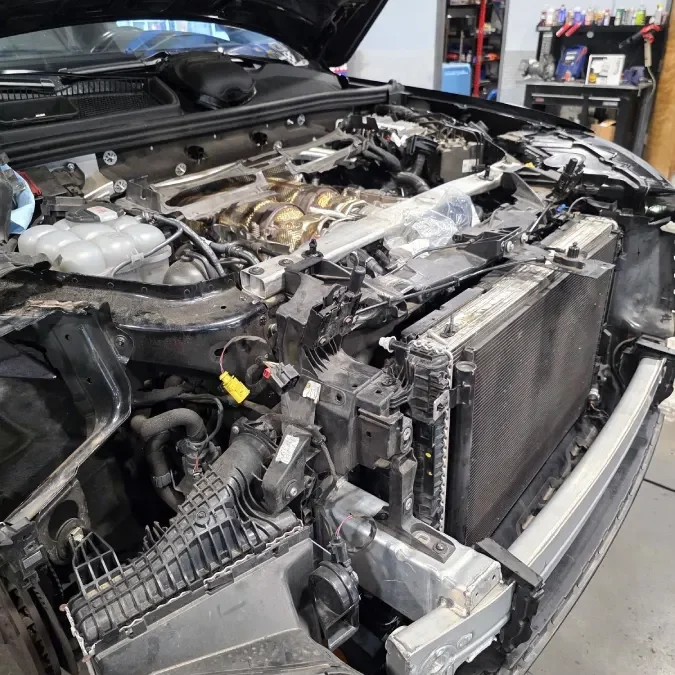
Car overheating is a stop-now problem. If your temperature gauge is climbing or a coolant warning light comes on, pull over somewhere safe, turn off the engine, and leave the hood and coolant cap alone until the engine has cooled. Don’t keep driving to “make it home.” A few more minutes of overheating can turn a small repair into a big one.
Car overheating: what to do right away
- Pull over as soon as it’s safe. A parking lot, side street or wide shoulder is fine.
- Turn off the engine and switch on your hazard lights.
- Do not open the radiator cap or coolant cap while the engine is hot. The cooling system is under pressure, and hot coolant can spray out and badly burn you.
- Stay clear of the hood if you see steam. Let it stop on its own.
- Wait at least 30 minutes. Longer is better. Don’t try to speed it up by pouring anything on the engine.
Once you’re safe, start lining up help. If you’re searching for auto repair near me that knows German cars, do it now so you’re ready to make the call when the shop opens.
Car overheating signs: the warning light and gauge
On most cars the temperature gauge sits near the middle when the engine is warm. If the needle is climbing toward the red zone, the engine is running hotter than it should.
You may also see a red thermometer symbol or a message such as “coolant temperature too high.” A low coolant warning is a separate message. Low coolant means the level has dropped. Overheating means the engine is already too hot. Neither one should be ignored.
Make a note of what you saw and when it happened: in traffic, on the highway, or right after startup. That detail helps a technician narrow down the cause.
Check the coolant level once the engine is fully cool
Low coolant is behind a lot of car overheating, so this is worth a look before you call anyone.
This is the only check we recommend. Wait until the engine is completely cool, park on level ground, and find the coolant reservoir. It is usually a translucent plastic tank with minimum and maximum marks. Read the level through the side. You don’t need to open the cap.
- Level between the marks: This doesn’t rule out a problem. A thermostat, fan or water pump issue can overheat a car with plenty of coolant.
- Below the minimum mark or empty: The system has probably leaked or lost coolant. Don’t drive the car.
- Signs you can see from where you stand: a sweet smell, a puddle under the car, or crusty residue around the reservoir. Look, but don’t crawl under the car or start poking at parts.
If you decide to add coolant, use only the type your owner’s manual specifies. German makes are particular about it, and the wrong type can cause trouble. Topping off is not a fix. If the level was low, coolant went somewhere.
Common causes of car overheating
- Low coolant or a leak. Aging hoses, plastic fittings, the radiator or the expansion tank can all start leaking.
- A thermostat stuck closed. It blocks coolant from circulating, so the temperature can spike quickly.
- A failing water pump. The pump moves coolant through the engine. When it weakens, the engine heats up, and you may see a leak or hear a noise from the front of the engine.
- A cooling fan that isn’t working. A car that overheats in traffic or at idle but runs normally at highway speed often points here.
A heater that blows cold air while the gauge is climbing can also mean the coolant level is low.
It is also worth checking whether your vehicle has an open cooling-system recall: enter your VIN at NHTSA’s recall lookup.
Why car overheating hurts German engines more
Many modern BMW, Mercedes-Benz, Audi, Volkswagen and Porsche engines use aluminum parts and plastic cooling components in a tightly packed engine bay. Aluminum expands more than iron when it gets very hot, so serious overheating can warp a cylinder head or damage a head gasket. Plastic thermostat housings, hoses and tanks can turn brittle with age and heat, and they often fail without warning.
That is why one overheating event matters more on these cars. It’s best to find the cause before the car is driven again.
Car overheating: when to stop driving and bring it in
Don’t drive the car, and arrange a tow through your roadside assistance or a towing company, if:
- The gauge went into the red or the warning message came on.
- You saw steam or smelled hot, sweet coolant.
- The coolant reservoir is low or empty.
- The car lost power or made new noises as it got hot.
If the gauge dropped back to normal and everything seems fine, get it checked anyway. Overheating that comes and goes usually means something is on its way to failing.
Getting car overheating diagnosed in Kennesaw
Blitz German Auto is in Kennesaw and works on BMW, Mercedes-Benz, Audi, Volkswagen and Porsche vehicles. We also serve drivers in Acworth, Marietta, Woodstock and across Cobb County. If you need auto repair near me for an overheating car, we can find where the heat is coming from and explain what needs fixing. You can read more about our German auto specialists or use the contact page to reach us. The shop is open Monday through Friday, 9am to 5pm.
Car overheating: common questions
Can I just add water if the coolant reservoir is low?
Plain water is at best a short-term stopgap and it dilutes the coolant mix. German makes specify a particular coolant type, so check your owner's manual and have the system looked at, because low coolant usually means a leak.
Why does my car only overheat in stop-and-go traffic?
At highway speed, airflow through the radiator does most of the cooling. In traffic the cooling fan has to do the work, so a weak or failed fan, or a marginal coolant level, shows up there first.
Can overheating once damage my engine?
It can, especially if the gauge reached red or you kept driving after the warning. Whether any damage was done can't be known without an inspection, so have the car checked even if it seems fine afterward.
Do you work on cooling system problems for all German brands?
Blitz German Auto repairs BMW, Mercedes-Benz, Audi, Volkswagen and Porsche vehicles, including engine and cooling-related diagnostics. The shop is in Kennesaw and serves Acworth, Marietta, Woodstock and the rest of Cobb County.