
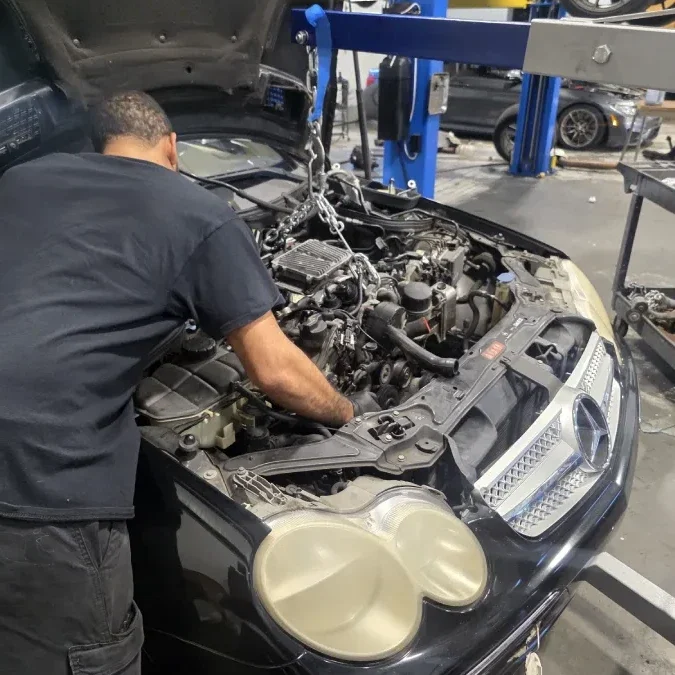
European car diagnostics take more than a basic code reader. A generic scan gives you a code, and that is only the starting point. On a BMW, Mercedes-Benz, Audi, VW or Porsche, finding the cause usually means reading the car’s multiple modules, checking live data and testing the actual part or circuit.
If you are searching for European car repair near me in the Kennesaw area, ask how a shop diagnoses a problem, not just what it replaces. The answer tells you a lot.
Why European car diagnostics need more than a code reader
Modern European cars run on many control modules. The engine, transmission, ABS, airbags, climate system, lighting and comfort features each have their own computer. They also talk to each other over a network, so European car diagnostics have to look at the whole car, not just the engine.
A basic reader usually pulls only generic engine and emissions codes. It often cannot reach the other modules or the brand-specific codes stored in them. As a result, you can leave with a code number and no real explanation.
Faults also spread. For example, a weak battery or a poor ground connection can set off warnings in several systems at once. Without reading every module, a technician can chase the wrong symptom.
What the process involves, step by step
A proper diagnosis follows a sequence. Here is what European car diagnostics typically include:
- Your description. First, the technician asks when the problem happens and what it feels like.
- Reading codes. Next, brand-capable software reads stored and pending codes from all available modules.
- Live data. Then the technician watches sensor readings while the car runs and compares them with what they should be.
- Visual inspection. Wiring, connectors, hoses, sensors and fluids get checked for damage, leaks or corrosion.
- Testing. Finally, the suspect part or circuit is tested directly to confirm the fault before any repair.
The last step matters most. Testing turns a suspicion into a confirmed cause.
The same process applies across brands. You can read more on our BMW diagnostics and Mercedes-Benz diagnostics pages.
European car diagnostics: why a code is not a failed part
A code tells you which circuit or system reported a problem. It does not say why. A misfire code, for example, can come from a worn spark plug, a failing ignition coil, an injector problem or a mechanical fault. A lean code can point to a vacuum leak, a dirty sensor or a fuel delivery issue.
Sensors are a common trap. A sensor can send a bad reading because its wiring is damaged, even when the sensor itself works fine. Replacing it would not help.
Replacing parts by guesswork wastes money. You may pay for a part that was never bad, and the real fault stays in place. Then the warning returns and you start over. This is why European car diagnostics aim to confirm the cause first.
What to note before your visit
Good notes make European car diagnostics faster and cheaper.
The more detail you bring, the faster a technician can narrow things down. Write down these points before the visit:
- When it started. Note when the light first came on, and whether it followed a cold start, fueling, rain or highway driving.
- Symptoms. Look for rough idle, hesitation, noises, smells, harsh shifting or a loss of power.
- Recent work. Include battery replacement, repairs, oil service or anything else done lately.
- Steady or flashing. Tell us whether any warning light blinks or stays on.
- Dash messages. Copy the exact wording, or take a photo with your phone.
Intermittent faults are hard to catch. So also note whether the problem shows up when the car is cold, warm or both.
Safe checks you can do first
These checks do not replace European car diagnostics, but they help you describe the problem.
You can do a few simple checks yourself while you arrange a visit. They also give the technician useful background.
- Warning lights: Note the color and symbol, and look it up in your owner’s manual.
- Fluid levels: Check oil and coolant using the method in your manual. Some cars show oil level through the dash menu, and coolant should only be checked when the engine is cold.
- Tire pressure: Compare each tire to the pressure listed on the driver’s door placard. The National Highway Traffic Safety Administration offers general tire safety guidance.
Stop there. Do not try to diagnose brakes, the fuel system, wiring or high-voltage components yourself, and do not lift the car.
Bring the car in without delay if you notice any of these:
- A check engine light that is flashing
- A brake warning light, a soft or sinking pedal, or grinding when you brake
- A fuel smell
- A burning smell, battery warnings or repeated electrical failures
In those cases, drive as little as possible.
Booking European car diagnostics near Kennesaw
Blitz German Auto Repair is at 3235 Odeon Way NW, Suite 110, Kennesaw, GA 30144. We serve nearby Acworth, Marietta, Woodstock and the rest of Cobb County. We work on BMW, Mercedes-Benz, Audi, Volkswagen and Porsche vehicles, and European car diagnostics are part of that daily work.
Our hours are Monday through Friday, 9am to 5pm. If you want European car repair near me that starts with a real diagnosis instead of a guess, begin on our Kennesaw page. You can also use our contact page to schedule a visit.
European car diagnostics: common questions
Can a cheap code reader handle European car diagnostics?
A basic reader can show generic engine and emissions codes, which is useful as a first look. However, European car diagnostics usually need access to the other modules and live data, and a basic reader often cannot reach them.
Will a scan tell me exactly which part to replace?
Not by itself, which is why European car diagnostics include hands-on testing.
Diagnosis aims to confirm the actual cause by reading codes, watching live data and testing the part or circuit. Sometimes the answer is a part, and sometimes it is wiring, a connector or a fluid issue.
Do you offer European car diagnostics for Volkswagen and Porsche as well as BMW?
Yes. Blitz German Auto Repair works on BMW, Mercedes-Benz, Audi, Volkswagen and Porsche vehicles, and the diagnostic process follows the same basic steps across those brands.
Why is the problem still there after a code was found?
A code is only the starting point of European car diagnostics.
A code points to the system that reported a fault, not necessarily the failed part. If a part was replaced without testing, the real cause may still be there and the warning can return.