
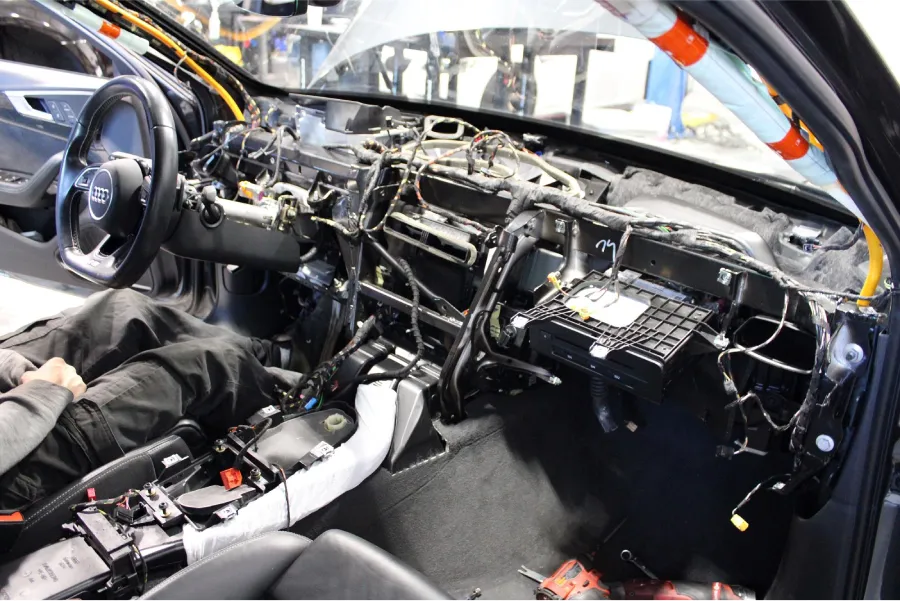
A German car technician works from the maker’s procedures and specifications, reads brand-specific data from your car’s control modules, and recognizes the patterns that tend to show up on BMW, Mercedes-Benz, Audi, VW and Porsche vehicles. That is the short answer. However, the real difference shows up in small daily decisions.
Our German Auto Repair technicians make those decisions on every job, so here is what they look like. Knowing them also helps you judge any shop you visit.
Matching the exact fluid and oil spec
Because these cars are built to tight tolerances, “close enough” is a bad habit. A German car technician looks up the approved specification for your exact car, then chooses a fluid that meets it.
Engine oil, for example, carries approval codes from the maker, not just a thickness rating. Coolant, brake fluid and transmission fluid also have specific requirements, so the wrong one can cause trouble later. That is why the technician checks the spec first instead of grabbing whatever is on the shelf.
Your owner’s manual lists what your car needs. The government’s fueleconomy.gov maintenance guidance also tells drivers to use the oil grade the manufacturer recommends.
How a German car technician follows factory-style procedures
A German car technician tightens key fasteners to a specified torque, in the specified order, using a torque wrench. Tightening by feel can warp parts or leave bolts too loose.
Some parts are also designed for one use. Stretch bolts, self-locking nuts and certain seals and gaskets fall into this group. Reusing them risks a loose joint or a leak, so the technician replaces them as the procedure calls for.
Some jobs need a step after the Repair, too. A new battery, for example, often has to be registered with the car’s electronics. Our post on German car battery replacement explains why these cars are picky.
Brake, fuel and lifting jobs are not driveway work. If your car needs any of them, bring it in.
Reading module data, not just one code
A modern German car has many control modules. Each one stores its own fault codes. A generic code reader sees only part of that picture.
Then the technician reads each module and checks live readings such as fuel trims, sensor values and temperatures. A German car technician compares those numbers with what they should be. For instance, a lean code could point to a vacuum leak, a dirty sensor or a fuel delivery problem. The live data shows which one fits.
That is also why a code alone is not a diagnosis. If your light is on, see our check engine light diagnostics page.
Where a German car technician expects wear and leaks
Experience with one group of cars teaches you where to look first. On many of these cars, a German car technician checks for oil seepage at the valve cover and oil filter housing gaskets, aging plastic coolant parts and hoses, and worn suspension bushings.
Heat and age are hard on rubber and plastic. These parts often wear out well before the metal around them. Checking them early lets the technician explain what is a slow seep and what is an active leak.
Wear patterns still vary by model. So the technician confirms each suspect on your car instead of assuming.
What a German car technician does to confirm a fix
Replacing parts until the problem stops is wasteful and unreliable. A German car technician tests first. That might mean pressure testing the cooling system, checking a sensor’s signal on live data, or tracing a circuit.
After the Repair, the technician clears the codes, road tests the car and rechecks the readings. If the fault stays gone, the fix is confirmed. If it returns, the diagnosis was incomplete and the testing continues.
What a German car technician should tell you after a diagnosis
You should leave with a clear picture, not a list of part names. Expect to hear:
- What was found, and how it was confirmed.
- Why it matters: safety, drivability, or damage if ignored.
- What needs attention now and what can wait.
- What to watch for on anything you postpone.
- What the Repair involves, in plain words.
If you are unsure how urgent a symptom is, our guide to urgent vs. can-wait car problems can help.
Book a visit in Kennesaw
Blitz German Auto Repair is at 3235 Odeon Way NW, Suite 110, in Kennesaw. We Repair all makes and models, with specialist expertise in BMW, Mercedes-Benz, Audi, Volkswagen and Porsche.
Drivers in Kennesaw, Acworth, Marietta and Woodstock can book a visit Monday through Friday, 9am to 5pm. Whether it is a warning light, a noise or an upcoming service, a German car technician can look at it. Reach our German Auto Repair technicians through the contact page to set up a time.
German car technician: common questions
Is a German car technician different from a general mechanic?
A general mechanic handles a wide range of vehicles. A German car technician focuses on brands like BMW, Mercedes-Benz, Audi, VW and Porsche, so working from the maker's specifications and knowing these cars' common patterns is routine.
Does a German car technician only work on German cars?
Not at Blitz German Auto Repair. We Repair all makes and models, with specialist expertise in BMW, Mercedes-Benz, Audi, Volkswagen and Porsche.
Why would a German car technician replace bolts instead of reusing them?
Some fasteners, such as stretch bolts and self-locking nuts, are designed for one use. Reusing them can leave a joint loose, so the technician follows the procedure and fits new ones.
Can a German car technician diagnose a check engine light from the code alone?
The code is only a starting point. The technician also reads module data and live readings, then tests the suspected cause before recommending a Repair.